
Innovators Converge to Bring Machine Learning Solution for Diagnosing Heart Attacks to Market
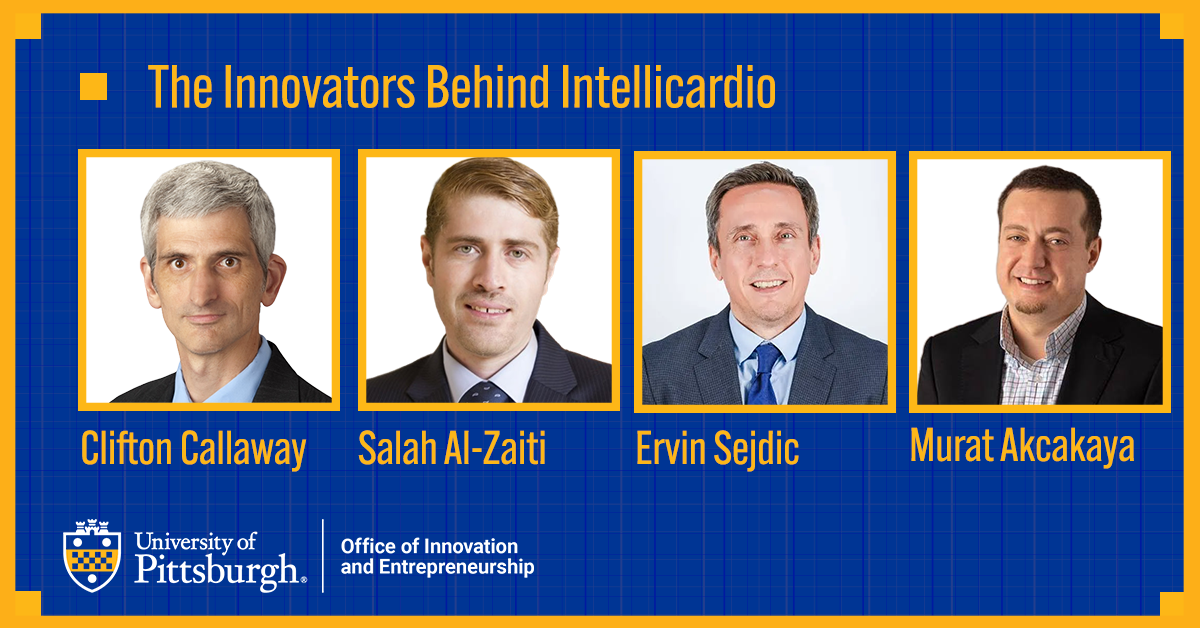
Every week, a group of cross-disciplinary, geographically dispersed researchers holds a virtual meeting to chart the path forward for commercializing their long-running research project.
As their careers have sent them in different physical directions, they have remained connected by their exploration, begun in 2013, into whether machine learning applied to a basic electrocardiogram (EKG) test can deliver a game-changing heart attack diagnosis with greater accuracy – potentially expediting treatment for those at most risk, while also reducing time in the emergency room for those not at risk.
Now that they have validated their prediction model on EKG data from more than 10,000 patients, with another 20,000 on the way, they have optioned the intellectual property from the University of Pittsburgh, launched a startup company, Intellicardio, and initiated conversations with the FDA about their regulatory approval path. They have also begun courting potential investors.
The closer they get to bringing their decade-plus of research to the point of real-world impact, the more their excitement grows.
“We now have a product that can change the standard of care that we want to commercialize,” said Intellicardio co-founder Salah Al-Zaiti, professor of nursing, cardiology, and electrical & computer engineering at the University of Rochester. “It has been a long time coming, but now we can see the opportunity coming to fruition.”
Decoding Hidden Signals
The research began with the framing of a problem by Al-Zaiti when he was an assistant professor in the Pitt School of Nursing.
“When patients come into the hospital with chest pain and/or related symptoms, the workflow is time-consuming and is plagued by flawed diagnostics,” he said.
He wondered if there was a way to analyze the electrical signals of an EKG via machine learning to explore patterns relative to clinical outcomes, providing enhanced predictive insight. To begin his exploration, he recruited Clifton Callaway, distinguished professor and executive vice chair of the Pitt Department of Emergency Medicine, to the project. Callaway had lived through this problem almost daily as an emergency physician.
“I look at an EKG, and sometimes it’s obvious someone is having a heart attack. But that is only a small percentage of the cases,” he said. “Every other time it could be a heart attack, but you can’t be sure until you run other tests. Oftentimes, that turns into a wait of 6-12 hours.”
“Every other time it could be a heart attack, but you can’t be sure until you run other tests. Oftentimes, that turns into a wait of 6-12 hours.”
This creates a delay in care for people who need it and needless waiting for those who don’t. After their initial concept showed promise, they received a four-year NIH grant in 2018, which was renewed in 2022 for an additional five years. During this period, Al-Zaiti relocated to the University of Rochester, which became a new data-gathering site, in addition to the initial two sites – Pittsburgh and North Carolina.
To date, their data has shown that their AI tool increases the predictive sensitivity of an EKG by 35 percent, approaching the accuracy of a blood test that can take several hours to get results in an emergency room.
To build the technical components of their platform, Al-Zaiti approached Ervin Sejdic of the Swanson School of Engineering to lead the development of signal processing and AI decision support capabilities.
“He (Al-Zaiti) needed help with the engineering for the data analysis, but we were just dirt-poor assistant professors,” Sejdic said laughing. “Of course, none of us had funds to do it until he published a few papers and was successful in obtaining the first R-01 grant from the NIH.”
Sejdic, who moved on to the University of Toronto in 2021, said they were doing “AI in medicine before it was popular”, and when they had a paper published in Nature Medicine, they became known as the people “with the algorithm nobody else has.”
Charting a Commercial Path
Al-Zaiti said the market for software as a medical device is large and growing fast.
“We know it’s one of the hottest fields for investors,” he said. “Our advantage is that there are only a handful of companies that specialize in AI-powered EKG analysis. And in that sub-category, we have a highly trained interface for acute cardiac emergencies with a full diagnostic suite of all causes of chest pain.”
“We have a highly trained interface for acute cardiac emergencies with a full diagnostic suite of all causes of chest pain.”
As their research demonstrated increasing commercial potential, the team began working with Janice Panza, senior licensing manager at the Innovation Institute, part of the Office of Innovation and Entrepreneurship, to protect their growing portfolio of intellectual property and begin planning a commercialization strategy.
They have also been joined on their bi-weekly calls by Paul Petrovich, director of new ventures, who has guided them through the company formation process and helped negotiate the option for the intellectual property that they hope to convert to a full license over the next year.
For Callaway, the decision to pursue a startup rather than license the technology to an existing company came after a frustrating experience with licensing some of his own EKG analysis patents to a large company, which he said failed to commercialize them. At the same time, a competitor beat it to market with technology from another university.
“Salah (Al-Zaiti) decided with this particular IP (intellectual property) we would create a university spinout to get this to where it would help patients more quickly,” he said.
Ready for Real World Deployment
One reason why they will be ready to move quickly once receiving regulatory approval is because they have been working in tandem in their roles as researchers and clinicians with UPMC Presbyterian Hospital and Pittsburgh EMS. Working directly with a major medical center and emergency services organization would be difficult to do in most other places, they said.
“UPMC is one of the leading medical centers for emergency medicine research,” Al-Zaiti said. “We are building a real-time interface at Presby that can be used prospectively for patient care. It is being deployed at Presby with the Heart and Vascular Institute.”
One of the clinicians who consulted on the project that has led to the creation of Intellicardio, Christian Martin-Gill, is excited at the prospect of the platform making a commercial debut.
Martin-Gill, professor of emergency medicine and chief of the Division of Emergency Medical Services, is an emergency physician who also makes runs with ambulance services and the emergency helicopter transport service, STAT Medevac, has been working with Al-Zaiti for more than a decade to collect data in pre-hospital settings.
“What we’re working on now is developing a dashboard physicians can access in real-time and get substantially enhanced interpretation of the EKG to help them make better decisions before the patient even arrives,” he said. “This dashboard has explainability. It shows which parts of the EKG the clinician should focus on. The next stage will be testing in clinical care and seeing how best to deploy it and detect patients with heart attacks that were not immediately diagnosed.”
The last member to join the project, Murat Akcakaya, associate professor of electrical and computer engineering, came on board four years ago to provide additional machine learning expertise as they worked to refine their algorithms, fine-tune the signal processing, and improve the ability to deliver results in real time.
Akcakaya explained that a primary advantage of Intellicardio’s platform is that it runs as a cloud application directly integrated into the hospital’s IT systems, enhancing security and data privacy.
“I’m very excited to see that this is moving forward,” said Akcakaya, who is the new company’s Chief AI Officer. “I have always been interested in developing a product that combines hardware and software to help a specific population.”
Clearing the Final Hurdles
Al-Zaiti said the company has begun working with regulatory consultants and looks forward to an initial discussion with the FDA in the coming weeks, leading to the submission of a 510K application. This designation would mean that their product is “substantially equivalent” to an already marketed product. While they could be required to provide additional clinical data, they likely would not need to conduct a full clinical trial.
“Right now, we are raising money to get through the regulatory phase,” he said.
Petrovich, the Innovation Institute’s new ventures director, is confident that Intellicardio will be successful.
“I’ve worked with a lot of founding teams, and what sets this one apart is how quickly they absorb feedback, adjust course, and engage. They’re not attached to doing things a certain way — they’re attached to the outcome, which is getting this into hospitals where it can actually save time and save lives.”
The gap between a research question and a market-ready product is rarely short — but after 13 years, Intellicardio is proof that going the distance pays off, for the team and for the patients whose lives may depend on it.