
AgeTech Innovation Challenge funding brings a low-cost, dignity-preserving shower solution one step closer to people who need it most
The bathroom is the most dangerous room in a house, and for people with balance and mobility challenges, it can be especially treacherous.
A new innovation from the University of Pittsburgh’s Healthy Home Laboratory (HHL) will give people who have difficulty standing or walking the ability to shower safely on their own.
The remote shower control (RSC) device proposal received a $50,000 award through the AgeTech Innovation Challenge, a joint initiative of the HHL and the Office of Innovation and Entrepreneurship (OIE) to support pre-commercialization activities, in addition to mentoring support from the OIE.
Team leader Paulina Villlacreces, assistant professor at the School of Health and Rehabilitation Sciences, who is also director of product development for the HHL, said the RSC was inspired by another HHL team member, Todd Hargroder, who has used a wheelchair since a spinal cord injury at age 19. Hargroder said that since his accident, he has required assistance getting into the shower.
“Once I’m seated in the shower, the shower controls are a foot and a half out of my reach,” he said, creating a risk of falling forward to adjust the valve controls.
Hargroder said the goal is to create a system that is easy for people to install on their own and portable for use outside the home.
He has been innovating solutions for people with physical challenges for over two decades, including wheelchairs with lightweight carbon-fiber backrests and the first wheelchair disc brakes. After selling his first company in 2015, he launched another in 2022, Soul Mobility, whose flagship product transforms manual wheelchairs into lightweight power chairs in a few simple steps.
John Riley, the OIE entrepreneur-in-residence mentoring the RCS team, said that after an introductory meeting, he is confident in the commercial potential for their innovation.
He said the device has both institutional and retail market potential because it is more cost-effective than high-end digital products on the market, many of which require costly plumbing upgrades.
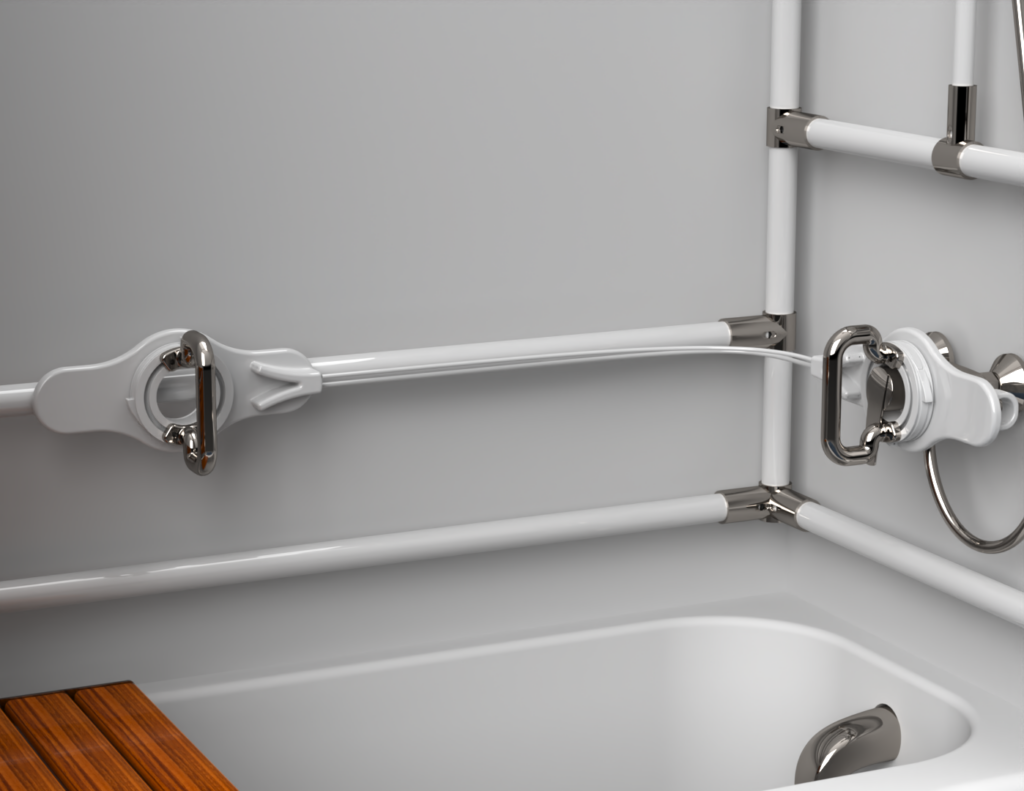
How it Works
The RSC device consists of a manual or electronic control unit installed wherever is most convenient for the user, such as a shower wall near a bench seat. This unit is connected via a mechanical transfer system consisting of cables and bearings that control a mechanism attached to the existing shower control fixture, allowing the user to adjust the water pressure and temperature from the position most comfortable for them without needing to stand up or maneuver.
Villacreces said the RSC can give a measure of independence and dignity for users while relieving caregivers of a difficult task and the embarrassment of being in the personal space of another adult.
The Scope of the Problem
More than 234,000 injuries occur annually in the bathroom, with adults age 65 and older, and those afflicted with spinal cord injuries, ALS, and multiple sclerosis most severely impacted. Reaching for a shower valve requires these users to twist and strain, which can cause falls, Villacreces said.
For the more than 1 million people living with spinal cord injury, ALS or MS, bathing is particularly hazardous. Villacreces pointed to a study showing more than half of individuals surveyed from these groups experienced difficulty bathing.
Those with MS can also suffer a phenomenon where showering in hot water can cause increased fatigue, making them prone to falls.
Additionally, people afflicted with ALS or spinal cord injuries can be slow to recognize scalding water temperatures, resulting in thousands of hospitalizations each year.
From Prototype to Pilot
Zachary Roy, a HHL research engineer, said that the team had developed early prototypes using a 3-D printer that were refined with feedback from focus groups of users and clinicians.
Jon Pearlman, associate dean of commercial translation at the School of Health and Rehabilitation Sciences, said the AgeTech challenge award will assist with redesigning the current prototype with additional focus groups, including having users come to the HHL to use its simulated bathroom.
“We will finalize the prototype and produce up to five units to be used in a field evaluation in people’s homes,” he said.
The team then plans to apply for a Small Business Innovation Research (SBIR) grant for further commercial development. SBIR grants are non-dilutive grants distributed by 11 different federal agencies to fund small businesses to conduct research and development on innovations with high commercialization potential.
The team is also working with Innovation Institute (part of the OIE) licensing manager, Tara Branstad, on protecting the intellectual property they have developed and continue to produce.
A Living Laboratory for Aging in Place
The HHL is a unique Pitt lab that includes an actual home near the Pitt campus where scientists, engineers and rehabilitation experts design and test solutions to allow people to age safely and independently at home.
The shower valve project is one of several innovations within the HHL. A sampling of the lab’s other projects include Mobius. This adaptable rail system allows grab bars and other accessibility hardware be added to a wall without costly renovation, in addition to a movable handrail and a cable-driven support system to help older adults keep climbing stairs safely rather than switching to a passive stairlift. The HHL team is also evaluating smart-home sensors and indoor air quality tools as part of a broader effort to make ordinary houses safer for aging residents.